Truchet tiles
A square with two arcs in it, rotated at random, is enough to draw curves that wander across the whole floor and never cross.
In 1704 Sébastien Truchet published a study of square tiles split along a diagonal into two colours, and counted the patterns that their four orientations could make. The version most people now call a Truchet tile is a later variant, described by Cyril Stanley Smith in 1987: each square carries two quarter-circle arcs, each joining the midpoints of two neighbouring sides.
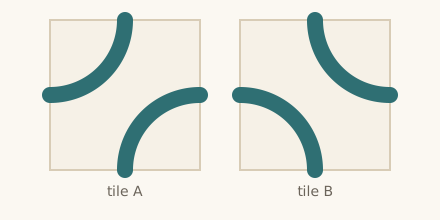
Because every arc ends exactly at a midpoint, any arrangement of the two tiles joins up. Arcs from neighbouring squares meet at the shared midpoint with the same tangent, so the result is a set of smooth curves, and since the two arcs in one tile never touch, curves never cross each other. Each curve either closes into a loop or runs off the edge of the grid.
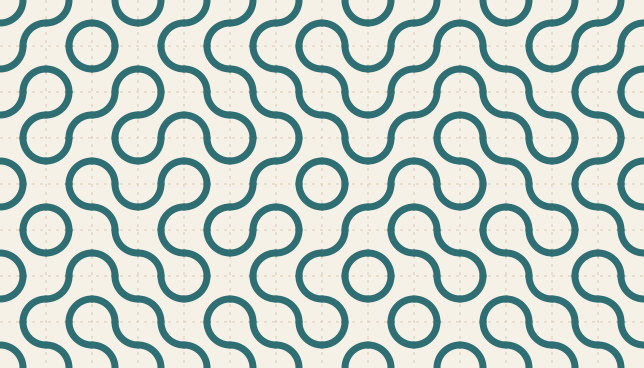
The regions between the curves can always be coloured with two colours so that neighbours differ. The quick way to see it: colour the corners of the square grid like a chessboard. Each arc cuts off exactly one corner of its tile, so every region contains grid corners of a single colour, and regions on the two sides of an arc get opposite colours.
Things to try:
- Bias the coin. With probability 0.9 for one tile the curves become long diagonal stripes; at 0.5 they look like a maze.
- Replace the quarter circles by straight segments between the same midpoints. The curves turn into zig-zag paths with corners.
- Use hexagons with three arcs per tile, each joining the midpoints of two neighbouring edges. There are again two ways to place a tile, and the curves still never cross.