Three regular tilings, and why only three
Copies of a single regular polygon, meeting edge to edge, can fill the plane in exactly three ways. The argument is short enough to keep in your head.
The interior angle of a regular polygon with n sides is (n − 2)·180°/n. Where tiles meet edge to edge, some number k of them share a vertex and their angles have to add up to a full turn, 360°. So 360° divided by the interior angle must be a whole number.
- n = 3: the angle is 60°, and six triangles meet.
- n = 4: 90°, four squares.
- n = 6: 120°, three hexagons.
- n = 5: 108°, and 360/108 ≈ 3.33. Pentagons leave a gap or overlap.
- n ≥ 7: the angle is bigger than 120°, so fewer than three would meet, and two polygons cannot close a vertex.
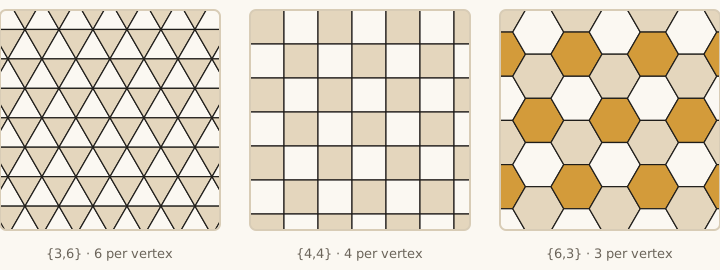
The Schläfli symbol {p,q} records the polygon and how many meet at each vertex: {3,6}, {4,4} and {6,3}. Swapping the numbers gives the dual: put a dot in the centre of every tile and connect dots of neighbouring tiles. Triangles and hexagons are dual to each other; the square grid is its own dual.
Of the three, hexagons enclose a given area with the least total edge length. That this is optimal among all ways of dividing the plane into equal areas is the honeycomb conjecture, proved by Thomas Hales in 1999. Bees found the answer earlier.
Dropping the word “regular” opens everything up. Every triangle tiles the plane, and so does every quadrilateral, convex or not: rotate a copy by half a turn about the midpoint of each side and keep going. Pentagons are where the story becomes long; the Cairo tiling is one small corner of it.