The repeat unit
Every periodic pattern hides a small tile that, copied and shifted, rebuilds the whole thing. Finding it is the first thing I do with any pattern I want to understand.
A pattern in the plane is periodic when some shifts map it exactly onto itself. Take all such shifts together and they form a lattice: there are two independent vectors a and b, and every shift that works is an integer combination m·a + n·b.
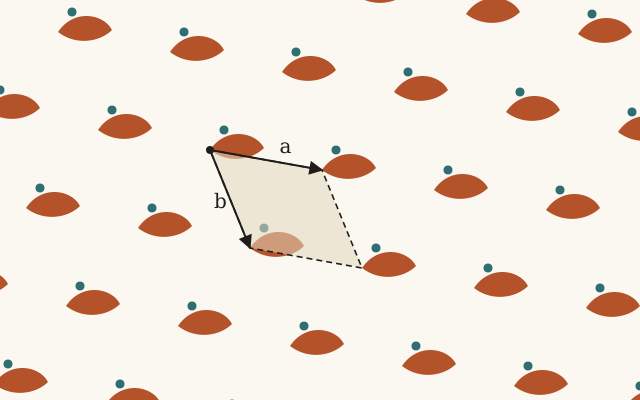
Any parallelogram spanned by such a pair is a repeat unit (crystallographers say primitive cell). Shift copies of it by the lattice vectors and they cover the plane with no gaps and no overlaps; whatever is drawn inside the cell is all the information the pattern has.
The cell is not unique. A different basis, say a and a + b, gives a longer, thinner parallelogram that works just as well. What does not change is the area: it is the absolute value of the determinant of the two vectors, |a×b|. That gives a useful sanity check. If you think you have found a smaller repeat unit than before, its area must be the old one divided by a whole number, otherwise something is off.
A practical recipe
- Pick a point that is easy to recognise: a place where three colours meet, the tip of a leaf.
- Find its nearest copy. The arrow to it is a.
- Find the nearest copy that is not on the line through a. That is b.
- Draw the parallelogram and trace what is inside. Then imagine sliding it by a and by b.
Smaller than the repeat unit
If the pattern also has rotations or mirror lines, even less is needed. A fundamental domain is a piece that, moved by all the symmetries of the pattern (not only the shifts), fills the plane. For a pattern with fourfold rotations a quarter of the repeat unit can be enough. The bookkeeping of which symmetries can occur together leads to the seventeen wallpaper groups, which deserve their own note.