Vertex notation and the Archimedean tilings
Allow more than one kind of regular polygon, but insist that every vertex looks the same, and you get exactly eight tilings.
A compact way to describe a vertex is to walk around it and list the polygons you pass. 4.8.8 means a square and two octagons; 3.6.3.6 means triangle, hexagon, triangle, hexagon. The regular tilings in this notation are 3.3.3.3.3.3, 4.4.4.4 and 6.6.6.
The angles have to add up to 360°. For 4.8.8 that is 90° + 135° + 135°. For 3.12.12 it is 60° + 150° + 150°.
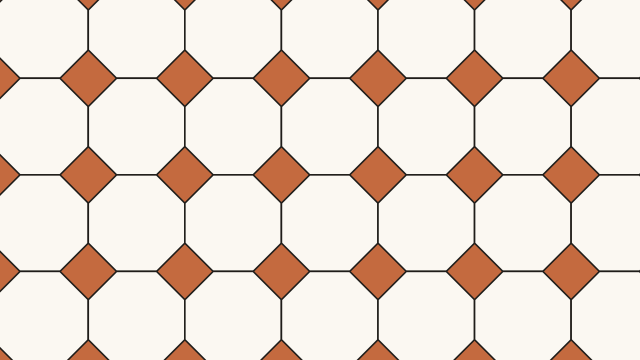
Edge-to-edge tilings by regular polygons in which every vertex has the same arrangement are called semi-regular or Archimedean. There are eight of them:
- 3.12.12 and 4.6.12, the two with twelve-sided polygons;
- 4.8.8, shown above;
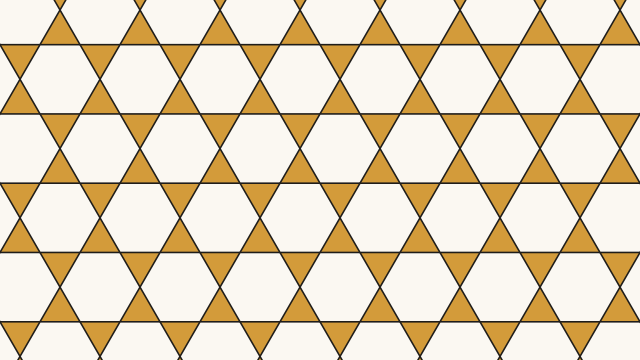
- 3.6.3.6 and 3.4.6.4;
- 3.3.4.3.4 and 3.3.3.4.4;
- 3.3.3.3.6, which comes in two mirror-image forms.
Adding up to 360° is necessary but not sufficient. 5.5.10 works out (108° + 108° + 144°), yet it cannot be extended into a tiling: walk around one of the pentagons and its neighbours would have to alternate between pentagons and decagons, which a five-sided polygon cannot do. Checking each candidate this way is how the list of eight is pinned down.