The Cairo pentagonal tiling
Regular pentagons cannot tile the plane, but plenty of irregular ones can. This is the friendliest of them.
The name comes from the paving said to be common on streets in Cairo. It is easy to draw from a square grid: in every square put a short segment through the centre, horizontal and vertical squares alternating like a chessboard, and connect each end of the segment to the two nearest corners of its square.
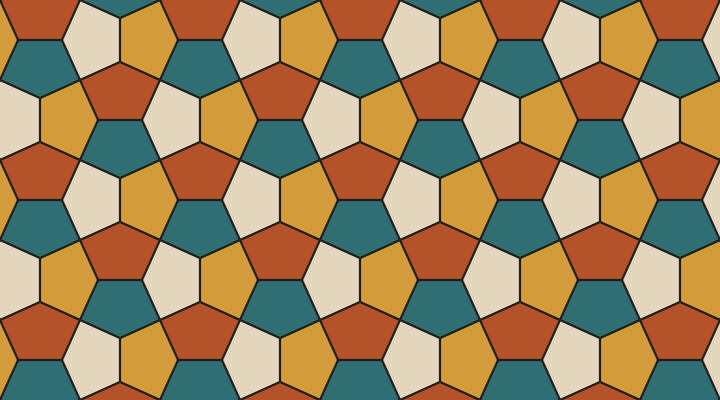
Each square ends up cut into two trapezoids and two triangles, and each pentagon is a trapezoid from one square joined to a triangle from the square next to it. The original grid lines disappear.
The length of the segment is a free parameter. In the version drawn here it is chosen so that all five sides of the pentagon are equal: if the squares have side 1, the segment has length (√7 − 1)/3 ≈ 0.549. The angles are then two right angles, two of about 114.3° and one of about 131.4°. Another common version uses angles of 120°, 120°, 90°, 120°, 90° and has one side shorter than the other four.
Two more ways to see it:
- It is the dual of the Archimedean tiling 3.3.4.3.4: put a point in each tile of that tiling and join neighbours.
- Pairs of pentagons form elongated hexagons, and the whole tiling is two hexagon tilings laid at right angles to each other.