Basketweave, herringbone and other brick bonds
Give a bricklayer a 2:1 rectangle and you get a dozen named patterns. Two of them are good exercises in finding the repeat unit.
The simplest bonds are rows: stack bond lines the joints up, running bond shifts every row by half a brick. Basketweave works in squares of two bricks, alternating horizontal and vertical pairs like a chessboard. Herringbone sets every brick at right angles to its neighbours in a zig-zag staircase.
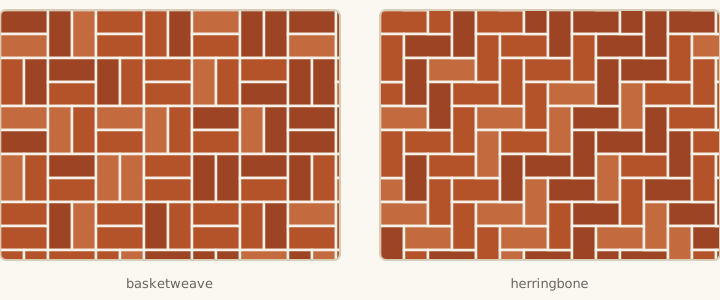
Basketweave is a good test of the area check from the first note. The obvious axis-aligned square, four by four in units of the short side of a brick, does repeat, but it holds eight bricks. Shifting by (2, 2) also maps the pattern onto itself, and so does (2, −2); the cell they span has area 8, which is four bricks: one horizontal pair and one vertical pair. The square was two repeat units.
Herringbone is more interesting. Measure in units of the short side of the brick and put the corner of one horizontal brick at the origin. Walking one step along the staircase shifts everything by (1, 1); jumping to the neighbouring staircase shifts it by (2, −2). The determinant of these two vectors is 4, which is the area of exactly two bricks. So the repeat unit holds one horizontal and one vertical brick, even though the pattern looks busier than that.
Pavers like herringbone for driveways because every brick is held on all sides by bricks running the other way, so the surface does not creep under load. Turned by 45° it is usually called diagonal herringbone; the geometry, and the repeat unit, are the same.