Hexagonal grids and three coordinates
Square grids get two coordinates for free. Hexagon grids are happier with three that always add up to zero.
The usual way to store a hexagon map is in rows and columns with every other row shifted by half a cell. That works for storage and makes everything else awkward: the neighbours of a cell depend on whether its row is odd or even.
A cleaner choice uses three coordinates q, r, s along the three directions of the grid, with the rule q + r + s = 0. Think of the hexagons as the diagonal slice through a stack of cubes, which is where the name cube coordinates comes from.
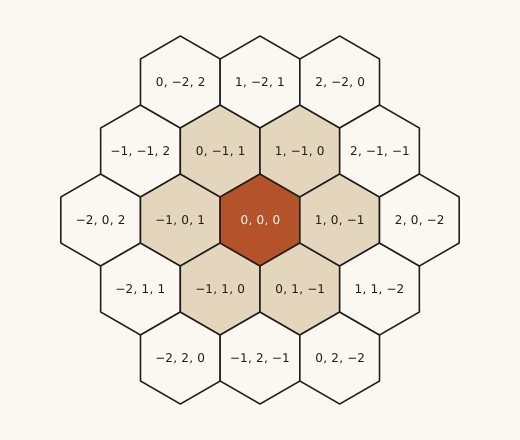
- Neighbours are the six permutations of (+1, −1, 0) added to a cell.
- Distance between two cells is max(|Δq|, |Δr|, |Δs|), which equals (|Δq| + |Δr| + |Δs|)/2.
- Counting: a hexagonal map of radius N has 3N(N + 1) + 1 cells: 1, 7, 19, 37, …
- Rotation by 60° about the centre is a cyclic shift with a sign change: (q, r, s) → (−r, −s, −q).
Since s is always −q − r, only two numbers need to be stored (axial coordinates), and the third is recovered when it is useful. Converting a cell to a point on the screen is a fixed linear map; flat-topped and pointy-topped grids differ only in that map, and everything above stays the same.